By Dan Beard
|
 |
|
 |
|
 |
|
 |
|
 |
|
 |
|
|
Land-Lubber's Chapter |
 |
|
 |
The Land-Lubber's Chapter
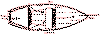
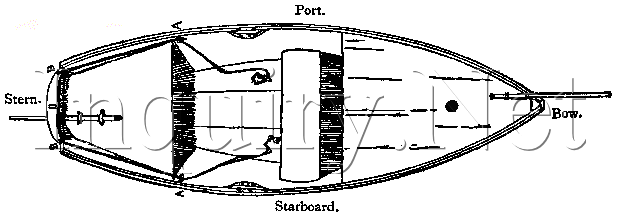
Fig. 104
Top View of Small Boat
THERE are a few common terms with which all venture on the water should be familiar, not for convenience, but for prudential reasons.
Accidents are liable to happen to boats of all descriptions, and often the safety of property and life depend upon the passengers' ability to understand what is said to them by the officers or sailors in charge of the craft.
To those who are familiar with the water and shipping it may seem absurd to define the bow and stern of a boat, but there are boys who will read this page who cannot tell the bow from the stern, so we will begin this chapter with the statement that
 |
The bow is the front end of the boat, and |
|
The stern is the rear end of the boat. |
|
Fore'ard (Forward) is toward the bow of the boat. |
|
Aft is toward the stern of the boat. Both terms are used by sailors as forward and backward are used by landsmen. |
|
The hull is the boat itself without masts, spars, or rigging. A skiff and a birch bark canoe are hulls. |
|
The keel is the piece of timber running along the Center of the bottom of the hull, like the runner of a skate, and used to give the boat a hold on the water, so that she will not slide sideways. |
When you are sitting in the stern of a boat, facing the bow, the side next to your right hand is the right- hand side of the boat, and the side next to your left hand is the left-hand side of the boat ; but these terms are not used by seamen; they always say
|
Starboard for the right-hand side of the boat, and |
|
Port for the left-hand side of the boat. |
Formerly the left-hand side was called the larboard, but this occasioned many serious mistakes on account of the similarity of the sound of larboard and starboard when used in giving order.
Red and Green Lights
After dark a red light is carried on the port side and a green light on the starboard side of all vessels in motion. If you can remember that port wine is red, and that the port light is of the same color, you will always be able to tell in which direction an approaching craft is pointing by the relative location of the lights.
When both lights you see ahead,
Port your helm and show your red!
Green to green and red to red,
You're all right, and go ahead!
If you are a real land-lubber, the verse quoted will be of little service, because you will not know how to port your helm. In fact, you probably will not know where to look for the helm or what it looks like; but only a few of our readers are out-and-out lard-lubbers, and most of them know that the helm is in some way connected with the steering apparatus.
|
The rudder is the movable piece of board at the stern of the boat by means of which, the craft is guided. The rudder is moved by a lever, ropes, or a wheel. |

Fig. 105
Helm--Lever, or Stick for Tiller
|
The tiller is the lever for moving the rudder, or the ropes used for the same purpose (Fig. 105). |
|
The wheel is the wheel whose spokes end in handles on the outer edge of the rim or felly, and it is used for moving the rudder (Fig. 106). |
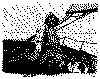
Fig. 106
Helm--The Wheel
|
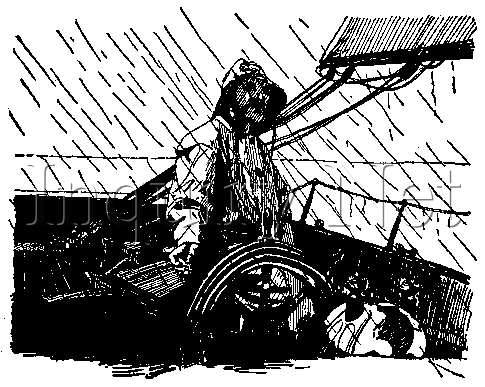
The helm is that particular part of the steering apparatus that you put your hands on when steering. |
|
The deck is the roof of the hull. |
|
The center-board is an adjustable keel that can be raised or lowered at pleasure. It is an American invention. |
The center-board, as a rule, is only used on comparatively small vessels. For sailing, the boat or bull is rigged with masts and spars for spreading the sails to catch the wind.
|
The masts are the upright poles or sticks that hold the sails. |
|
The yards are the poles or sticks at right angles with the masts that spread sails. |
|
The boom is the movable spar at the bottom of the sail. |
|
The gaff is the pole or spar for spreading the top or head of the sail (Fig. 107). |

Fig. 107
A Sail
|
The sail is a big canvas kite, of which the boom, gaff, and masts are the kite-sticks. |
You must not understand by this that the sail goes soaring up in the air, for the weight of file hull prevents that; but if you make fast a large kite to the mast of a boat it would be a sail, and if you had line long and strong enough, and should fasten any spread sail to it, there can be no doubt that the sail would fly.
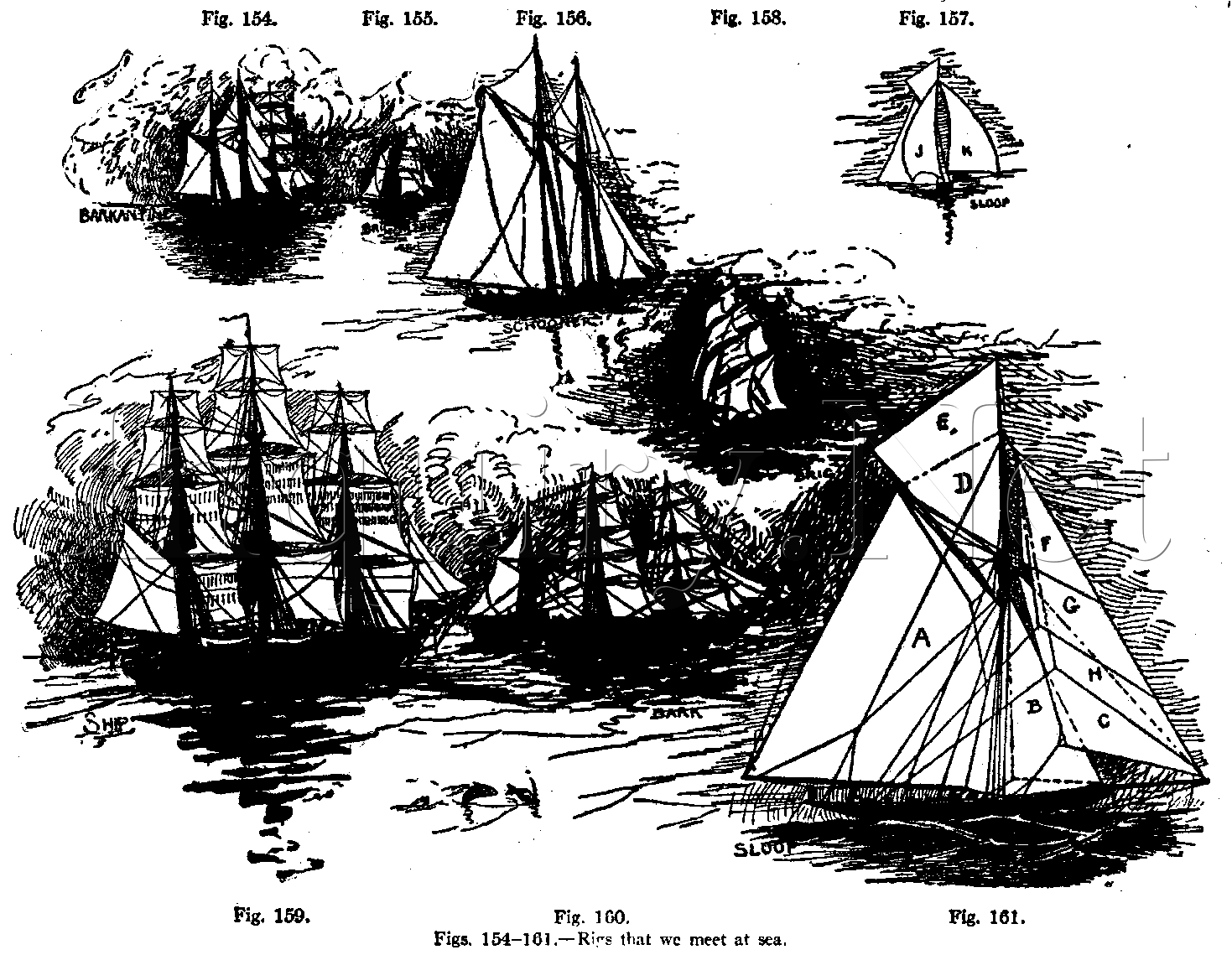
[Note: Figures 130-137 Mentioned Below,
May be Found in this Illustration from the
Beard's Boat-Building and Boating]
|
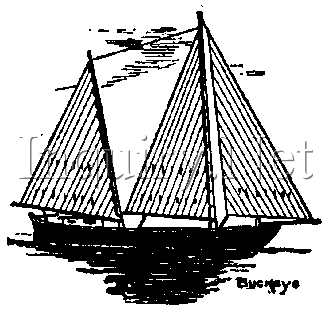
The spars are the masts, bowsprit, yards, and gaffs. |
|
The bowsprit is the stick or sprit projecting from the bow of the boat (Fig. 137, Sloop). |
|
The foremast is the mast next to the bow--the forward mast (Fig. 135, Ship). |
|
The mainmast is the second mast-the mast next to the foremast. |
|
Mizzen-mast is the mast next to and back of the mainmast (Fig. 135, Ship). |
|
The rigging of a boat consists of the ropes or lines attached to its masts and sails, but a boat's rig refers to the number of masts as well as to the shape of its sails. |
|
Stays are strong ropes supporting the masts, fore and aft. |
|
Shrouds, to strong ropes reaching from the mast-heads to the sides of the vessel; supports for the masts, starboard and port. |
|
Ratlines are the little ropes that form the steps or foot ropes that run crosswise between the shrouds. |
|
The painter is the rope at the bow of a small boat, used for the same purpose as is a hitching-strap on a horse. |
|
The standing rigging consists of the stays and shrouds. |
|
The running rigging, of all the ropes used in handling yards and sails. |
|
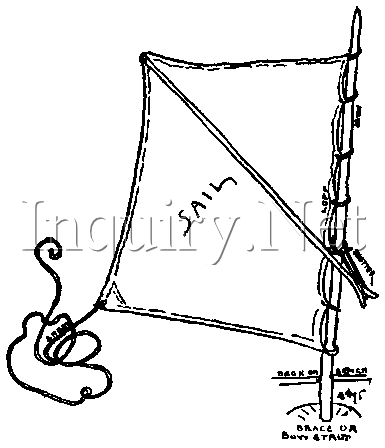
The sheets are the ropes or lines attached to the corners of sails, by which they are governed (Fig. 108). |

Fig. 108
Sail and Sheet
|
The main sheet is the rope that governs the mainsail. |
|
The jib sheet is the rope that governs the jib sail. |
|
The gaskets are the ropes used in lashing the sails when furled. |
|
The braces are the ropes used in swinging the yards around. |
|
The jib stay is the stay that runs from the foremast to the bowsprit. |
|
The bob stay is practically an extension of the jib stay and the chief support of the spars. It connects the bow of the boat with the bowsprit and prevents the latter from bobbing up and down. |
Besides the port and starboard sides of a boat there are the windward and leeward sides. Do not understand by this that the boat has four sides like a square. Windward may be the port or the starboard side, according to the direction the wind blows; because
|
Windward means the side of the boat against which the wind blows; the side where the wind climbs aboard; or it may mean the direction from which the wind comes. The opposite side is called |
|
Leeward--that is, the side of the boat opposite to that against which the wind blows, where the wind tumbles overboard, or the side opposite to windward. When you are sailing you may be near a |
|
Lee Shore--That is, the shore on your lee side against which the wind blows, or a |
|
Windward Shore--That is, the land on your windward side from which the wind blows. |
All seamen dread a lee shore, as it is a most dangerous shore to approach, from the fact that the wind is doing its best to blow you on the rocks or beach. But the windward shore can be approached with safety, because the wind will keep you off the rocks, and if it is blowing hard, the land will break the force of the wind.
In a canoe or shell the boatman sit, either directly n the bottom, or, as in the shell, very close to it, and the weight of his body serves to keep the boat steady, but larger crafts seldom rely upon live weights to steady them. They use
|
Ballast--That is, weights of stone, lead, iron, or sand, bags used to balance the beat and make her steady. |
As has been said before in this chapter, the sail is a big canvas kite made fast to the boat, and called a sail, but the ordinary kite has its covering stretched permanently on rigid sticks.
The sail , however, can be stretched to its fall extent or only partially, or it may be rolled up, exposing nothing but the masts to the force of the wind. To accomplish all this there are various ropes and attachments, all of which are named.
It is quite important that the young sailor should know the names of all the
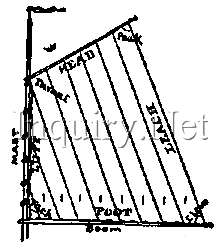
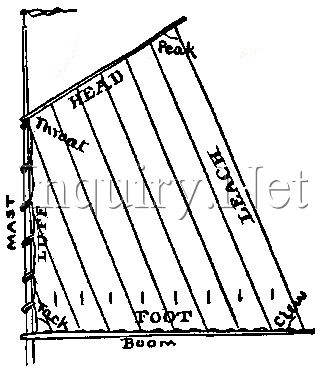
Parts of a Sail

Fig. 109
Parts of Sail
|
Luff--That part of the sail adjoining the mast-the front of the sail (Fig. 109). |
|
Leach--That part of the Sail stretched between the outer or after end of the boom and the outer end of the gaff-the back part of the sail (Fig. 109). |
|
Head--That part of the sail adjoining the gaff-the top of the sail. |
|
Foot--That part of the sail adjoining the boom- the bottom of the sail (Fig. 109). |
|
Clews--A general name for the four corners of the sail. |
|
Clew-- The particular corner at the foot of the sail where the leach and boom meet (Fig. 109). |
|
Tack--The corner of the sail where boom and mast meet (Fig. 109). |
|
Throat or Nock--The corner of the sail where gaff and mast meet (Fig. 109). |
|
Peak--Corner of the sail where the leach and gaff meet (Fig. 109). |
 Dan Beard's