By A. W. N. Mackenzie
The Treasure Hunt is an excellent game for training the path-finding and deductive powers of the boys, and it never fails to hold their interest.
The details of Treasure Hunts are dependent on local conditions, but the following examples may prove of guidance.
No. 1 Treasure Hunt
(where all clues are handed out at beginning of hunt).
Each Patrol was given a bundle of sealed and numbered envelopes and a sheet of paper stating the boundaries. They were informed that the Treasure was the name of the shopkeeper on the building for which they were to search and that each envelope contained a further clue. The envelopes wire to be opened in the order 1, 2, 3, etc., as Patrols found that they could not proceed further without more information.
All Patrols had to return to Headquarters within 2 1/2 hours, whether they had found the Treasure or not.
The winning Patrol was the one which found the Treasure, having opened the fewest envelopes.
Envelope No. 1 said: A white building 1 1/4 miles (as the crow flies) from Headquarters in an N.E. direction.
Envelope No. 2 said: The building has the same number of chimney stacks as the Chief Scout has children and the same number of chimneys as there are Scout Laws. One of the chimneys is minus a top piece. The building is on the Rouken Glen/Bishop-Briggs tram route.
Envelope No. 3 said:

Envelope No. 4 said: Close to a re-built railway bridge
Envelope No. 5 said: Opposite a bowling green.
No. 2 Treasure Hunt
(where only one clue is given and the others have to be picked up).
Patrols start off together, each with a copy of the first clue and with instructions to return in two hours.
1st Clue: A piece of paper with , "Try what a little heat will do" written on it.
Explanation: Under the message was the second clue written in milk (or lemon juice) which is brought out by heat.
2nd Clue: "Follow the sun's way for 50 yards to the arrow's mother."
Explanation: 50 yards west was a yew tree (from which arrows are made).
Pinned to the yew tree was the 3rd clue which said:
3rd Clue: "EeIeSeEsSsLlEnLeEeLsLlEdEs, EsInLsNe EsLsNe SnLsEeEs, IiLlEsLs. LnNiSlLs EsInLsEnLs."
Explanation:
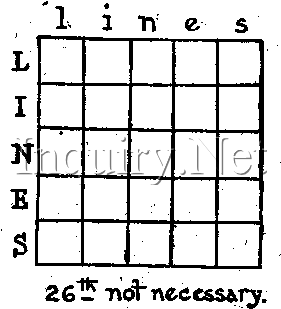
From the top, left-hand corner, from left to right, the squares spell A, B, C and so on to Y. As the clue states Z is not necessary. The clue reads "Sixty yards east, then ten west, gate. Clue there." Pinned by a drawing pin beneath the bottom spar of the gate was the 4th clue which said:
4th Clue: Find a red stone, find a rustic seat. Both can be seen from here. Midway between is further help. (Please replace this clue)." Which proved to be
5th Clue: Scout signs in the form of twigs laid thus:

Explanation: The clue means: "Go this way for 25 paces," which gave the
6th Clue: Scraped on a path: 
A message was hidden behind a loose stone in a wall in direction of arrow saying:
7th Clue: "Tree with unnatural fruit 75. Bring fruit." (Replace clue.)
Explanation: An apple (the Treasure) attached to a fir tree. As no direction was given, Scouts had to make a circle 75 yards round the clue till they found the unnatural fruit.
Treasure Hunt No. 3
(Based on knowledge of Scoutcraft and Requirements).
Each Patrol is handed copies of all clues and is told that the Treasure is a piece of money.
NOTE: In this case the Treasure was a penny stuck edgeways in the ground in long grass.
Clue No. 1: Proceed to the N. corner of wall surrounding Vicarage garden. From there you will see several clumps of trees. One of these clumps is almost exactly N.N.E. There is a single larch tree in the clump. Make your way to it.
Clue No. 2: 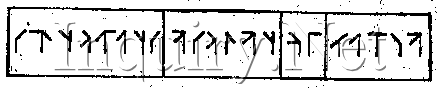
Clue No. 3: "Look. in direction in which sun sets and you will see a white five-barred gate. Proceed to gate calculating distance from larch to gate on the way."
Clue No. 4: "Follow path (to left) from gate to point where it joins main road. Draw rough journey map from gate to main road."
Clue No. 5:
Cross bearing:
No. 1: Chimney stalk and W. edge of fir wood.
No. 2: Railway signal and flagpole, Treasure here.
NOTE: In addition to points scored for finding the Treasure further points should be awarded for estimation of height and distance, and for the journey map.
No. 4 Treasure Hunt.
The Torn Paper: Two teams start simultaneously to find the Treasure.
Theme: An old man lay dying and before passing away he handed to his sons a sheet of paper describing minutely how they should proceed, to find a valuable treasure which he had hidden for safety.
Unfortunately they were seen by one of a gang of desperados who determined to steal the sheet of paper at all costs.
Scenting danger, the sons decided to tear the paper in two and to hide the pieces in different places. When ready to start out on their quest they were horrified to discover that the desperados had, a moment before their arrival, found one of two pieces of paper and started off in search of the treasure also.
Sample
Torn Message
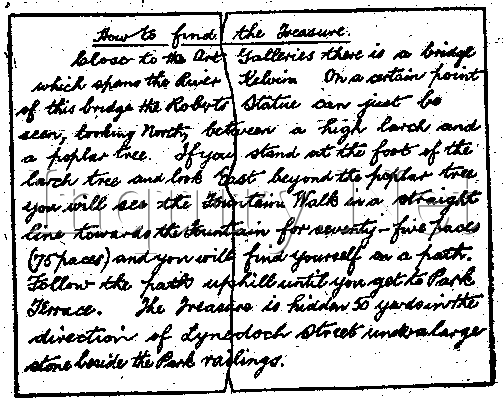
The sons, with the other half of the paper to guide them, immediately followed.
No. 5 Treasure Hunt.
The Blazed Trail
The Scoutmaster went for a stroll and, from his starting point, he noted some readily distinguished object, such as an isolated fir tree, and noted it down.
From this spot he walked to his next object (or "blaze"), say, the east corner of a shed, noted it down and so on until his "blazes" were complete.
Patrols were each given a list of the consecutive "blazes" to be followed en route to the Treasure. To avoid Patrols tumbling over each other on the hunt the starting point was indicated in a simple code message which had first to be deciphered.
On the last "blaze" (which was I a spruce tree) the following message was pinned:
"Find a rose which never bloomed."
The treasure, which was hidden inside the rose of a watering can, near the spruce tree, was a message saying:
"Congratulations! You win."
Patrols might be sent over different routes, of the same distances, to the Treasure. The "blazes " could be a different color of wool thread for each Patrol which could be tied on trees, fences, gates, etc.
