Home ] Up ] Books ] Search Inquiry ] Contents ]
Pole House


Adirondack Lean-To
Bark Teepee
Beaver-Mat Huts
Boys' Den
Boy's Gym
Daniel Boone Fort
Covered Council Ring
Dixie
Fallen-Tree, Peel Bark
Half-Cave Shelter
Indian Communal
Indian Shelters
Lean-To: Wilderness
Log Tents
Mandan Council House
Mossback
Newbrunswick
North Woods
Old Tents
Pole House
Pontiac
Racks and Wrinkles
Red Jacket
12' Tepee Plans
Wire Kens
Woodcraft Cabin
Woodcraft Stone Cabin
Woodcraft Outhouse


Search Now:


In Association with Amazon.com


By Dan Beard

sss171.gif (28797 bytes)
Figs. 171-179.
The Use of the Saw in Log Work
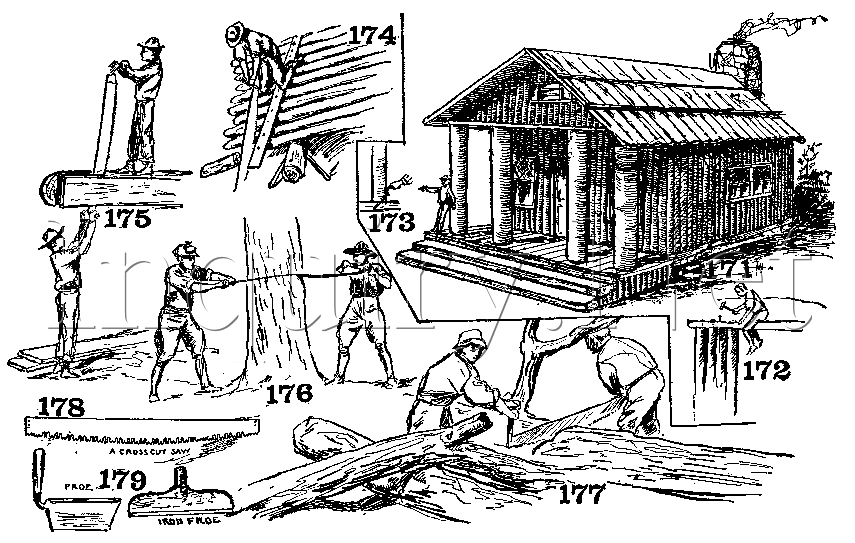
A POLE HOUSE. HOW TO USE A CROSS-CUT SAW AND A FROE

Pole House

Fig. 171 shows a pole house-- that is, a house, the walls of which are made by setting straight poles up on end with sides against each other and nailing a beam across the top (Fig. 172) and toe-nailing them (Fig. 173); that is, driving the nails slantingly down through the poles to the sill beneath. 

Fig. 172 shows how to nail them to the top beam or side-plate. To build a pole house, erect the four corner-posts and any intermediate posts which may be necessary, nailing the plates on top of the posts to hold the frame together (Fig. 172), afterward fitting the other posts in place, as shown in the sketch.

We have not yet arrived at the part of the book where we can build as extensive houses as the one shown here. The drawing is only inserted at this place because it naturally comes with the use of the cross-cut saw. You can, however, without much trouble, build a small pole house without the veranda, and after you have learned how to build the big log houses you can turn back to this page and try a pole house like Fig. 171.

Sawing on an Angle

Fig. 174 shows how to saw off poles on the bias, as some would say, or on an angle, as others would say.  Suppose, for instance, you want to cut the poles to fit the dormer over the veranda shown in Fig. 171. Measure off the height of the middle pole, then the distance along the base from the middle pole to the corner at the eaves. Next fit the poles you are going to use closely together to cover that distance; hold them in place by nailing a plank temporarily across the bottom ends; then place another plank at the point marked for the height of the middle pole, run it down to the bottom plank, and nail it temporarily along this line. 

Now take hold of one end of the saw, as the fellow does in Fig. 174, and let another boy take the other end of the saw; then by working it back and forth along the line you may saw off the protruding ends of the poles. Proceed in the same manner along the base-board. You will then have half the dormer poles all nicely tacked together and cut in the right shape so that they may be evenly fitted in place, and after they are secured there the marking planks may be knocked off. 

Fig. 175 shows two boys at work "pit-sawing." They are sawing planks from a log, which is rather hard work but not unpleasant. I know, for I have tried it when I was up among the moon-shiners in the mountains of Kentucky. 

Fig. 176 is from a sketch I made up in Michigan, where two men were sawing down a tree as they frequently do nowadays in place of chopping it down with an axe; this tree, however, was first notched with an axe so that it would fall in the right direction. 

Fig. 178 shows the peculiar teeth of one of these two-handled saws. It is not necessary for you to be expert on the sort of teeth a saw should have; any saw that cuts well for your purpose is the sort of saw you need. 

The Froe 

Fig. 179 shows two forms of the froe, an implement used for splitting shakes and shingles and clapboards like those on the roof of Fig. 171. The froe is held by the handle with the left hand and hammered on the top with a mallet held in the right hand. 

Fig. 177 shows two boys sawing a log up into sections, but for our work in cabin building the woodsman's axe is the real tool we need. The saw is all right and may be used if you have it, but it is a little too civilized for real woodcraft work. You cannot throw one of these saws over your shoulder as you would an axe and go marching into the woods with any comfort. The saw is also a more dangerous implement around camp than even a sharp axe.

See Also:

How to Use an Axe

How to Split Logs

Log-Rolling

How Logs are Notched

Seton's Use of the Axe

Traditional Camping Shelters

Shelters, Shacks, and Shanties


Additional Books

Site Contents
[Warning: Large File]

Search  Inquiry Net

Back Home Up Next


Additional Information:

Peer- Level Topic Links:
Adirondack Lean-To ] Bark Teepee ] Beaver-Mat Huts ] Boys' Den ] Boy's Gym ] Daniel Boone Fort ] Covered Council Ring ] Dixie ] Fallen-Tree, Peel Bark ] Half-Cave Shelter ] Indian Communal ] Indian Shelters ] Lean-To: Wilderness ] Log Tents ] Mandan Council House ] Mossback ] Newbrunswick ] North Woods ] Old Tents ] [ Pole House ] Pontiac ] Racks and Wrinkles ] Red Jacket ] 12' Tepee Plans ] Wire Kens ] Woodcraft Cabin ] Woodcraft Stone Cabin ] Woodcraft Outhouse ]

Parent- Level Topic Links:
Outdoor Skills ] Games for Boys! ] Shelters ] Camp Fires ] Night Skills ] Native American ] Checklists ] WINTER ] SPRING ] SUMMER ] AUTUMN ] Activities ]

The Inquiry Net Main Topic Links:
Traditional Scouting ] Adult Association ] Advancement ] Ideals ] Leadership ] Outdoors ] Patrol Method ] Personal Growth ] Uniforms ]

Search Amazon.Com:
W
hen you place an order with Amazon.Com using the search box below, a small referral fee is returned to The Inquiry Net to help defer the expense of keeping us online.  Thank you for your consideration!

Search:
Keywords:
Amazon Logo


 DVDs for Junior Leader Training Weekends!


Additional Titles: Scout Books Trading Post

Dead Bugs, Blow Guns, Sharp Knives, & Snakes:
What More Could A Boy Want?

Click on Underlined Green text to follow a hyperlink.  Let me know if you find a broken link, especially those that reference a hard drive :-/

Click on Small Pictures to Enlarge Them.  
If this enlarged picture won't print on a single page, search your software for a printing option like "Best Fit."  This is the default setting in most browsers.  
If the pictures are missing, send me the URL, and I'll scan them for you.  

To Email me, replace "(at)" below with "@"
Rick(at)Kudu.Net
If you have questions, you must send me the URL!
The URL tells me what page you're talking about.  This URL is sometimes called the "Address" and it is usually found in a little box near the top of your screen.  Most URLs start with the letters "http://"
Did I mention that you must send me the URL?

©2003, The Inquiry Net, www.inquiry.net: In addition to any Copyright still held by the original authors, the Scans, Optical Character Recognition, extensive Editing,  and HTML Coding on this Website are the property of the Webmaster, Rick Seymour.   My work may be used freely by individuals for non-commercial, non-web-based activities, such as Scouting, research, teaching, and personal use so long as this copyright statement is included in the text
The purpose of this Website is to provide access  to hard to find, out-of-print documents.  Much of the content has been edited to be of practical use in today's world and is not intended as historical preservation.   I will be happy to provide scans of specific short passages in the original documents for people involved in academic research.  

The Kudu Net is a backup "mirror" of The Inquiry Net.  When linking to this Website, note that pages that end in "inquiry.net" are updated far more often than the corresponding "kudu.net" versions.

Old School Scouting:
What to Do, and How to Do It!

Hit Counter
Since August 24, 2002
+550,762

Last modified: May 01, 2005.