by Ernest Thompson Seton
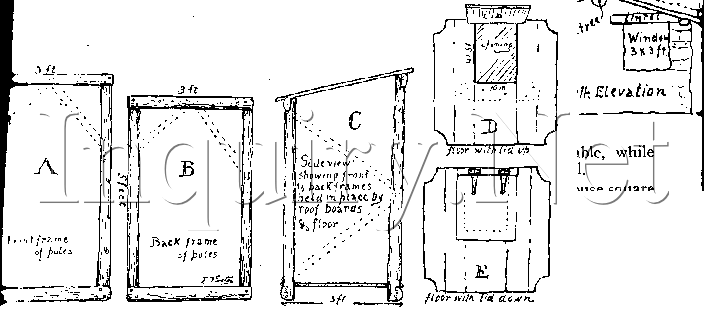
It is easy to buy a satisfactory sanitation department if you have several hundreds of dollars to spend; but the Woodcraft toilet may fairly claim to answer the ideal requirements and to be obtainable at a low cost and a little labor.
For this make a light sentry box, 3 feet by 3 on the ground plan; 5 1/2 feet high in front, and 5 feet behind. The frame may be of 3-inch poles or of 2 by 4's, or even of l 1/2-inch boards. If of poles, as in true Woodcraft, use only soft god and select straight poles.
Begin by making two frames, one for front and one for back, as in the diagrams A and B, each joint being made by cutting away half each pole and overlapping. Nail these together as in C. The roof boards at one end and the floor boards at the other hold the frames in place.
Leave out the middle part of the floor so that there is a hole 10 inches wide and 15 inches long (diagram D). The under-support to the short pieces of flooring is indicated by the dotted lines.
Cover the opening with a hinged lid that drops on to it (diagram E), fitting tightly when down, or resting back against the wall when up.
Note that there is no seat.
This style is the "hole-in-the-floor" plan. Theoretically, it is best. It gives the proper position to the body, with knees higher than hips.
But we were not brought up that way, and it may be well to make the slight compromise of a low seat. If this is used, it should not be over 14 inches
high, and the hole should be rectangular, not oval, 8 or 10 inches wide, and 18 to 20 inches from front to back, that is, the full width of the seat. This obviates all personal contact except on the two necessary places at the side that support the body. This opening should be covered with a fly-tight hinged lid.
The old-fashioned round or oval hole is a menace. At the front part especially the woodwork is likely to convey itch, lice, poison ivy and several horrible diseases.
In the Woodcraft toilet, this is entirely cut out.
The roof may be either of boards laid close or of thin slabs laid round side up and trimmed smooth.
The final cover of the roof is of tar-paper, as described in the cabin article.
If the sides are to be closed in with burlap or canvas, the angles should be braced as shown by the dotted lines in A, B, and C. If light boards are used, the braces are hardly needed.
For door, use either a curtain or a screen a couple of feet away.
Now dig a hole in the ground, 3 or 4 feet deep and about 2 feet square. Set the sentry box squarely and firmly over this. Have at hand a box of slacked lime with a trowel, and the affair is complete. Every time it is used, a little lime should be thrown in. The earth should be tightly banked up outside the house. The floor should be light-tight, using tar-paper when necessary. It is quite essential that the floor, the lid, and the pit be light-tight when the lid is down.
This toilet house has been found to be ideal-absolutely sanitary, natural, fly-proof, odorless, and costing almost nothing.
When no lime is at hand, ashes can be used, or even dry earth.
When the pit is nearly full, move the house, level it off with earth, then dig another pit, and set the house over that.
If a larger house is needed, make it on the same lines but 8 feet long and with 3 floor holes.
