Home ] Up ] Books ] Search Inquiry ] Contents ]
Kicking


Adam Poe Elevator
Breast Stroke
Chump's Raft
Frog Kick
Grapevine Cable
Hints on Swimming
Kicking
Slippery Slide
Spring Boards
Suspension Bridge
Swimming Hole
Tub Races
Water Bladder
Water Swing


Search Now:


In Association with Amazon.com


By Dan Beard

ohb249.gif (2469 bytes)
Fig. 249
Dancing-Jack Showing the Position of Legs for Swimming
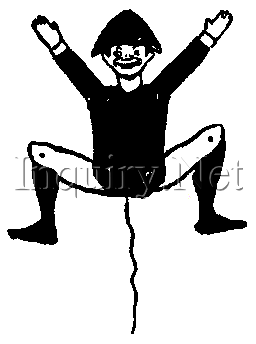
After you have gained confidence in your support, practice the frog's kick. Never mind your arms; It is possible to swim without them, as the frog has shown us. Do not draw your knees up under you, but spread your legs apart like a dancing-jack (Fig. 249)with your knees on each side. This, as has been shown, is the bull-frog's style. He knows his business and will take no points from us, though we may with advantage take some from him.

In kicking, strike the soles of your feet against the water as you would against the foot-board, were you lying face downward on your bed, and, like the frog, push the water from you. Finish the kick with the feet wide apart, then bring your legs close together, extending them in a straight line. At this point your toes must be turned down and your heels raised as far as possible, to lessen the resistance as you glide through the water. And glide you will, if the peg in the ducking-post is well greased and the kick properly made.

Do not be in a hurry to make the next kick. There is time enough to do that when the impulse forward that the first kick gave is dying out. Many old swimmers make the mistake of hurrying their kick and thus losing speed while making double the exertion necessary. T he Breast Stroke.

Gus Sundstrom, the champion long-distance swimmer and swimming master at the New York Athletic Club, in an article published ten years ago in the Harper's Young People, states that "this is the stroke that frogs use and always have used." Well, we will go to Gus to learn to swim, for he is a past grand master of the art. But we prefer to watch a frog ourselves, and by so doing we shall see that he does not use his little short arms, or his funny hands, with no web between the fingers. As already stated, he depends entirely upon his long muscular legs and big webbed feet to propel him through the water. So, in place of going to Mr. Frog for the breast stroke, we prefer to go to Gus, for he has no webbed feet and does depend upon his hands and arms to help propel himself.

He says that when you strike out you must "hold your fingers close together." Perhaps one of the principal uses of man's hands in the water is keeping his head up, so that he may breathe, and that is why he makes the stroke a little downward, for by pressing on the water he lifts his head.

OHB


Additional Books

Site Contents
[Warning: Large File]

Search  Inquiry Net

Back Home Up Next


Additional Information:

Peer- Level Topic Links:
Adam Poe Elevator ] Breast Stroke ] Chump's Raft ] Frog Kick ] Grapevine Cable ] Hints on Swimming ] [ Kicking ] Slippery Slide ] Spring Boards ] Suspension Bridge ] Swimming Hole ] Tub Races ] Water Bladder ] Water Swing ]

Parent- Level Topic Links:
Games of Ball ] Bee Messengers ] Boat Plans ] Dead Bugs ] Choosing Up ] Counting Out ] Leap Frog ] Swimming ] Tag ] Water Periscope ] Circus in the Woods ] Boys' Vaulting-Poles ] Woodcraft Camps ] Deaf Scout Jamboree 2006 ] Do It Yourself Camps ]

The Inquiry Net Main Topic Links:
Traditional Scouting ] Adult Association ] Advancement ] Ideals ] Leadership ] Outdoors ] Patrol Method ] Personal Growth ] Uniforms ]

Search Amazon.Com:
W
hen you place an order with Amazon.Com using the search box below, a small referral fee is returned to The Inquiry Net to help defer the expense of keeping us online.  Thank you for your consideration!

Search:
Keywords:
Amazon Logo


 DVDs for Junior Leader Training Weekends!


Additional Titles: Scout Books Trading Post

Dead Bugs, Blow Guns, Sharp Knives, & Snakes:
What More Could A Boy Want?

Click on Underlined Green text to follow a hyperlink.  Let me know if you find a broken link, especially those that reference a hard drive :-/

Click on Small Pictures to Enlarge Them.  
If this enlarged picture won't print on a single page, search your software for a printing option like "Best Fit."  This is the default setting in most browsers.  
If the pictures are missing, send me the URL, and I'll scan them for you.  

To Email me, replace "(at)" below with "@"
Rick(at)Kudu.Net
If you have questions, you must send me the URL!
The URL tells me what page you're talking about.  This URL is sometimes called the "Address" and it is usually found in a little box near the top of your screen.  Most URLs start with the letters "http://"
Did I mention that you must send me the URL?

©2003, The Inquiry Net, www.inquiry.net: In addition to any Copyright still held by the original authors, the Scans, Optical Character Recognition, extensive Editing,  and HTML Coding on this Website are the property of the Webmaster, Rick Seymour.   My work may be used freely by individuals for non-commercial, non-web-based activities, such as Scouting, research, teaching, and personal use so long as this copyright statement is included in the text
The purpose of this Website is to provide access  to hard to find, out-of-print documents.  Much of the content has been edited to be of practical use in today's world and is not intended as historical preservation.   I will be happy to provide scans of specific short passages in the original documents for people involved in academic research.  

The Kudu Net is a backup "mirror" of The Inquiry Net.  When linking to this Website, note that pages that end in "inquiry.net" are updated far more often than the corresponding "kudu.net" versions.

Old School Scouting:
What to Do, and How to Do It!

Hit Counter
Since August 24, 2002
+550,762

Last modified: May 01, 2005.