By Dan Beard
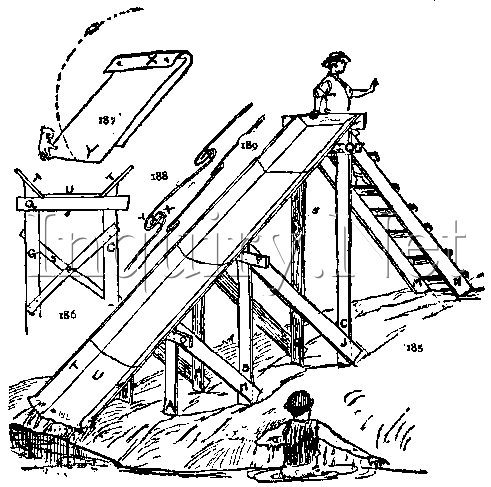
Figs. 185-189.
Details of a Wooden Slippery.
In Kentucky the boys make a "slippery" by the simple process of sitting down in the mud at the top of the bank and, with the aid of their hands and feet, working their way down to the water's edge, forming a furrow as they go.
But in the Northern and Eastern States, where the banks are rocky or composed of sand and gravel, the real "Kentucky Slippery" cannot be made. We can, however, build an artificial one of planks, as shown in Fig. 185. Don't be alarmed; there will be no danger of splinters; for the planks in this case are covered with pieces of canvas or cheap oilcloth such as is used to cover kitchen tables.
Make a trough by using one broad plank or two small planks for the center-piece (U, Figs. 185 and 186). This is supported by the cross-pieces O P Q, to which it is nailed. The sides of the trough are supported by the uprights A B C E F G, which are made firm by the braces H J K L M N. Fig. 186 shows a front view of a section of a trough.
Very few braces will be necessary on a small slippery, but if the structure is of such proportions that it has an inclination to wabble during use, the uprights may be further braced by the diagonal pieces S R, as shown in Fig. 186. The slanting sides to the trough make the most comfortable slippery, but if its construction tests your skill too severely you can make the sides (T, Figs. 185 and 186) upright like the sides of a box.
The braces (M N, Fig. 185) are made into a ladder by nailing cross-pieces upon them, as shown in the diagram. There is an oil-cloth stair-carpet which comes by the yard and may be obtained in long strips; if a strip of the right length of this material can be procured it will tend to simplify the work of covering the trough.
But in case you use the ordinary table-cover oil-cloth it must be tacked on the plank in such a manner that there shall be no danger of the coasters having a misunderstanding with a tack. To do away with all danger from tacks, commence at the bottom, as you would to s ingle a house, and let the piece of oil-cloth (X, Fig. 187) extend a few inches beyond the plank.
Now lay the next piece of oil--cloth (Y, Fig. 187) on top of X, as shown in the diagram. Curl the top of X over Y and tack it securely to the side pieces (T T, Fig. 186). Use no tacks on the centre (U).
When you have securely tacked X to the sides through the top of Y, bend Y up, as shown by the arrow in Fig. 187, and fold it over the top of X, as shown by the side views (Figs. 188 and 189).
Go through the same process with the next piece of oil-cloth. In this manner you can shingle your whole trough without exposing the head of a single tack or making a wrinkle to worry the coaster as he by the side views (Figs. 188 and 189).
Go through the same process with the next piece of oil-cloth. In this manner you can shingle your whole trough without exposing the head of a single tack or making a wrinkle to worry the coaster as he by the side views (Figs. 188 and 189).
Go through the same process with the next piece of oil-cloth. In this manner you can shingle your whole trough without exposing the head of a single tack or making a wrinkle to worry the coaster as he glides down to the water.
Figs. 188 and 189 show the edge of the oil-cloth, explaining more fully how this is done. After the side is covered with oil-cloth you will need some sort of lubricant. A pail of lard will probably answer the purpose very nicely, but it will necessitate a lot of soap to clean the lard off your body after you are through bathing; it will be better if you can get old-fashioned soft soap to cover the trough.
