By Robert De Groat
HOW THE CANADIAN GOVERNMENT SAVES ITS TOTEM POLES
 Since the advent of the white man the number of totem poles erected
annually by the Indian is fewer, and doubtless in a few more generations the Indian will
have adopted the white man's culture to such an extent that he will no longer trouble to
construct totem poles. The art of carving totem poles will be forgotten and no new
artists will be developed.
Since the advent of the white man the number of totem poles erected
annually by the Indian is fewer, and doubtless in a few more generations the Indian will
have adopted the white man's culture to such an extent that he will no longer trouble to
construct totem poles. The art of carving totem poles will be forgotten and no new
artists will be developed.
The poles at present existing are then to be considered as an artistic record that cannot be replaced and which in terms of actual money has a considerable value. The eagerness of museums to secure good specimens may be taken as an index of the value of the poles, but while the poles have a certain definite value in museums, they are worth more in the exact locality in which they have originally been erected. The difficulty is, however, that the poles in their natural setting, being constructed only of wood, decay under the influence of the weather and destructive fungi. When a pole once rots and falls it is only a matter of time until it is a mass of rotten brown wood.
The poles are usually from thirty to forty feet high and made of a single piece of cedar, generally about three feet in diameter. The base of the pole is sunk into the ground to a depth of about six feet. Cracks develop in the surface of the wood and often extend into it for several inches. The rotting takes place chiefly just at the ground level and all stages of decay have been reached in the existing poles.
Eventually the pole becomes so weakened by decay that it breaks off just at the ground level and falls. The poles apparently stand for about sixty to eighty years before they become weak enough to topple over.
The first part of the operation of reconstruction consists in supporting the pole by means of a small portable derrick, while it is cut off about the level of the ground. The pole is then lowered and the work of repair begins. The decayed part of the wood near the base of the pole is first cut away and a deep groove is cut in the back of the pole for almost its whole length. The new surface exposed in this groove is then thoroughly treated with creosote to prevent later decay.
A new seasoned pole sufficiently large to support the totern pole to be repaired and to project six feet or more from its base is provided and creosoted. The new pole is fitted into the groove in the back of the totem poles. The two units are fastened with about six countersunk bolts, the heads of which are concealed by wooden plugs. The plugs so resemble knots as to be inconspicuous. The seams are chinked with cedar strips, calked with oakum and covered with plastic gum. The gum seldom if ever runs and yet does not get very hard.
Minor repairs are made to the carvings and the pole is then coated several times with oil which has been well warmed in the sun. An attempt is made to have the oil soak thoroughly into the pole, since the fungi that cause decay cannot live where the oil penetrates, but a shiny surface or a thin skin of oil is to be avoided. Creosote penetrates deeply into the wood but does not take paint. The cracks in the pole are left unfilled, as a filling of putty would give the pole a new and somewhat unnatural appearance. Drainage is left at the bottom of all the cracks. The top of the pole is covered with plastic gum, then a layer of canvas and then another coat of plastic gum. The tops of some of the carvings, being seen from the ground, are treated in a like manner.
The restoration of the original colorings of the poles is often a difficult matter. None but the older Indians know what colors were used on the pole or on what surfaces color was applied. An old Indian was employed to select and apply the colors and was often helped by some of the other Indians. Occasionally he found himself unable to decide what color should be used on a particular figure. He would then be told to go among some of the older men and women and from their answers decide his problem.
A good quality of commercial paint is used in the work. The Indian painters have no ideas of using paints to give the appearance of having been long applied. In one case a member of the official party in charge of the work managed to give the paint an appearance of age but the Indians promptly went back to freshen up the painting. Possibly after longer acquaintance and a better understanding of the work they can be made to see the idea of restoring the pole to appear as a well preserved antique, but as the poles are part of their heritage, at present the work must be done as they wish.
However, the effects of weathering rapidly remove the air of modernity given by the new paint and if at a later time the consent of the Indians is obtained, ageing the painting of a pole will be little effort for one man and will require no expensive apparatus.
When work on the pole is finished and it is ready to be set in position, it is hoisted into place on a concrete base prepared near the original site, on such a level that the old pole comes just below ground surface. Concrete is then filled into the hole up to the base of the old pole. The pole is covered with plastic gum from the surface of the concrete to a height of about an inch above ground level. The concrete is then covered with sand and gravel so that none of it shows. In an area like Mexico or the desert regions of southwestern United States, cement or concrete would not be incongruous, but in Canada where wood is the chief medium of construction, the concrete would be out of place.
During all the hoisting operations, care is taken to protect the pole with pads against chafing by the ropes and to apply all the slings to the stronger parts so that the delicate carvings will not be harmed.
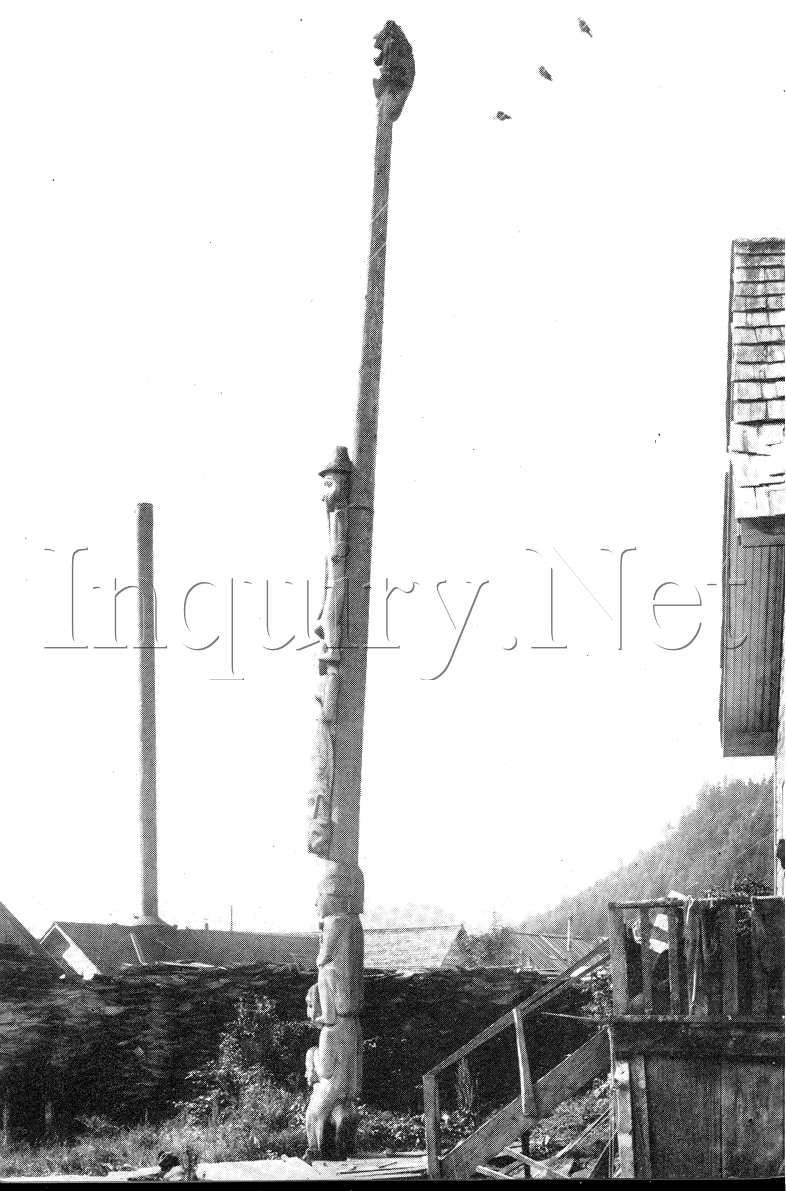 One of the important phases of the work is securing the cooperation of
the natives. The poles are the property of the heirs of the families represented.
They may not see the wisdom of the work, and their objections and suspicions must
be overcome before work can begin. The cooperation of the Indians is also required after
the actual work is finished if the effort is to be really useful and the poles protected
against defacement and destruction. To this end, the attempt is always made to
enlist the complete sympathy of the younger generation in the work, and it is hoped that
the restored poles will long remain as monuments to a fast vanishing culture and as an
earnest of our good will.
One of the important phases of the work is securing the cooperation of
the natives. The poles are the property of the heirs of the families represented.
They may not see the wisdom of the work, and their objections and suspicions must
be overcome before work can begin. The cooperation of the Indians is also required after
the actual work is finished if the effort is to be really useful and the poles protected
against defacement and destruction. To this end, the attempt is always made to
enlist the complete sympathy of the younger generation in the work, and it is hoped that
the restored poles will long remain as monuments to a fast vanishing culture and as an
earnest of our good will.
